

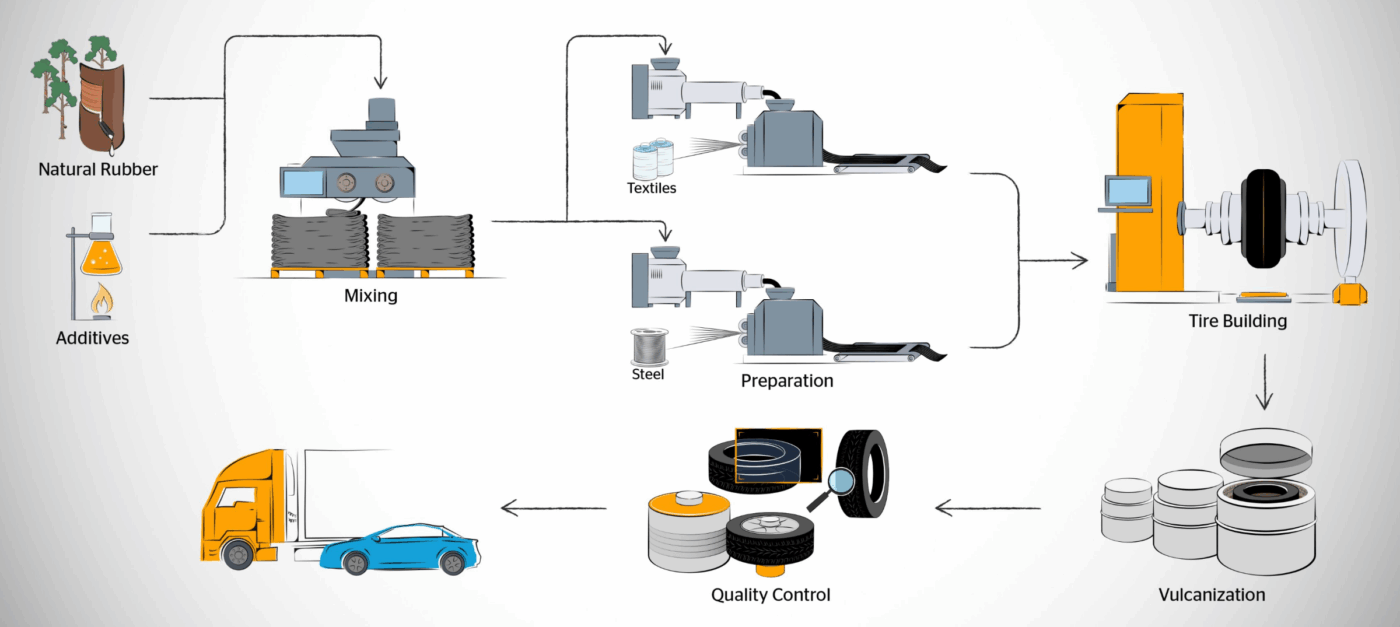
The tire manufacturing industry is a complex and precise process that transforms raw natural rubber into high-performance tires. With growing global demand for high-quality tires, sustainable tire production, and advanced tire technology, understanding this process is crucial for industry professionals. This article explores the key stages of tire production and the essential tire manufacturing machinery required at each step.
1. Rubber Mixing & Compounding (Tyrkaid Available)
The process begins with rubber compounding, where natural rubber is blended with additives like carbon black, sulfur, and oils to enhance durability, elasticity, and heat resistance.
Key Machinery:
- Internal Mixers (Banbury Mixers) – High-shear mixers for uniform dispersion.
- Two-Roll Mills – Refine rubber compounds before shaping.
2. Calendering & Sheet Preparation (Tyrkaid Available)
The mixed rubber is then processed into sheets of specific thicknesses using calendering machines. These sheets form the tire’s inner layers, including the tread, sidewall, and inner liner.
Key Machinery:
- Four-Roll Calenders – Produce precise rubber sheets.
- Rubber Extruders – Shape rubber strips for tread patterns.
3. Tire Building (Assembly)
Tire components—such as bead wires, steel belts, and fabric plies—are assembled layer by layer on a tire building machine. This stage determines the tire’s structural integrity.
Key Machinery:
- Tire Building Drum Machines – Automate ply and belt placement.
- Bead Winding Machines – Reinforce tire edges for stability.
4. Vulcanization (Tyrkaid Available)
The uncured “green tire” is placed in a tire curing press, where heat and pressure activate the vulcanization process, giving the tire its final shape and strength.
Key Machinery:
- Tire Curing Presses – High-pressure molds for perfect tread patterns.
- Autoclaves – Used for specialty tire curing.
5. Inspection & Testing (Tyrkaid Available)
Finished tires undergo rigorous quality control checks, including X-ray inspection, balance testing, and durability assessments to meet safety standards.
Key Machinery:
- Tire Uniformity Machines – Ensure even weight distribution.
- X-Ray Defect Detectors – Identify internal flaws.
Conclusion
From natural rubber processing to final tire inspection, each stage relies on specialized tire manufacturing machines to ensure performance, safety, and efficiency. As the industry evolves with automation in tire production and eco-friendly tire materials, manufacturers must invest in advanced tire machinery to stay competitive.
For the latest in tire production technology, explore our range of high-performance rubber mixing mills, calenders, and curing presses designed for modern tire factories.
